Scooter Space
DRSV, LLC.Sports
4.6410.00 Reviews
- Version
- 1.032
- Installs
- 5.00M
- Age Rating
- Everyone
Screenshots
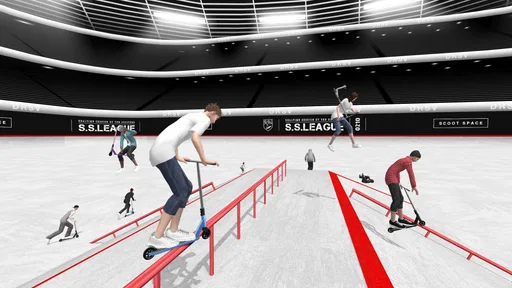
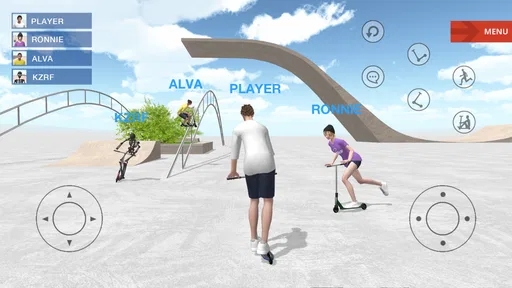
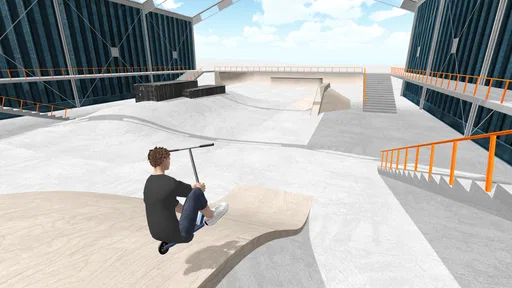
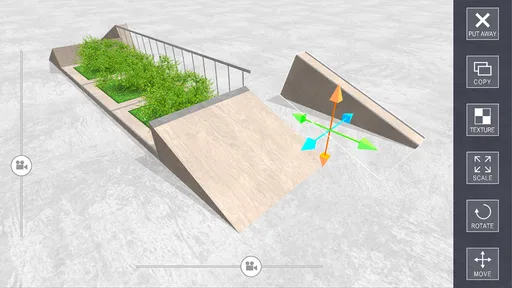
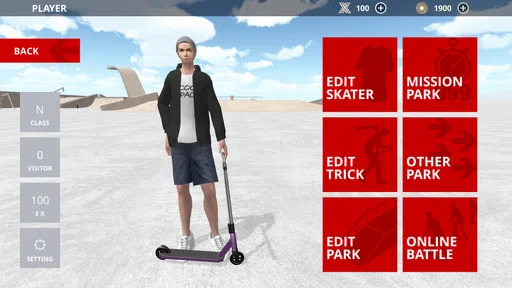
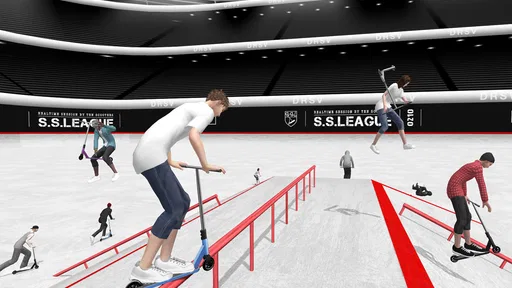
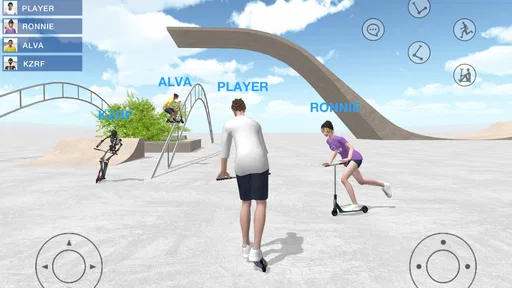
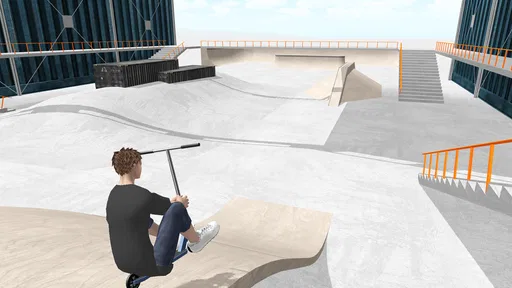
Our Review of Scooter Space
 Analysis by Appyee
I came to Scooter Space expecting a light sports game built around quick rides and short sessions, and that is mostly how it feels. Developed by DRSV, LLC., this free game puts the focus on scooter riding, custom parks, and online multiplayer sessions rather than on a long career campaign or a large collection of unrelated sports. I found it easiest to enjoy when I treated it as a casual place to practice lines, try jumps, and meet other players instead of expecting a full console-style simulation.
That distinction matters. The appeal is not simply that you can move around on a scooter; it is the combination of a personal riding space, different parks to explore, and the possibility of sharing sessions with other players. The game is rated for Everyone, so it is approachable for younger players and families, although online interaction still makes it sensible for parents to stay aware of how a child uses multiplayer features.
How the riding feels in everyday play
The first thing I noticed is that the game asks for a little patience before the movement becomes comfortable. Scooter controls can feel very responsive when I am making small adjustments, but that same responsiveness means a rushed swipe or tap can send a jump in the wrong direction. I had better results when I stopped trying to correct every movement at the last instant and instead planned the approach to a ramp or ledge a moment earlier.
In terms of perceived speed, Scooter Space feels more like a game of rhythm and positioning than a pure speed challenge. Open areas let me build momentum and move across a park quickly, while tighter sections make control more important than simply going faster. That balance gives the game a relaxed pace for exploration, but it may disappoint anyone looking for nonstop acceleration or an arcade racer with constant action.
My practical advice is to spend the opening minutes learning how much room the scooter needs to turn and how early a jump should be prepared. This is one of the less obvious ways to make the game feel faster: better anticipation reduces hesitation, and fewer emergency corrections make a run look smoother. I also found that repeating a short route was more useful than immediately wandering through every available area.
The custom-park idea gives that practice a purpose. Instead of treating every mistake as a failed attempt, I could use a familiar park to test one change at a time. I might approach the same obstacle from a different angle, slow down before the takeoff, or choose a wider landing area. That makes the game suitable for players who enjoy gradually improving a line, even though it remains casual rather than deeply technical.
Why the parks matter more than the headline features
The parks are where the game gains variety. A single riding space can become repetitive if there is only one obvious route, but a selection of custom environments encourages experimentation. I liked using a park first as a travel space, then returning to it with a specific goal, such as finding a cleaner route between two obstacles or practicing a jump without stopping.
This also changes how multiplayer sessions feel. When several people are using the same space, the fun is not necessarily about beating everyone in a formal race. It can be more about seeing what other players attempt, comparing routes, or simply sharing a session while each person explores. If you prefer clearly structured matches, rankings, and defined win conditions, this looser format may feel underdeveloped. If you enjoy showing movement and discovering spaces together, it is a better fit.
One useful habit is to separate exploration from performance practice. On the first visit to a park, I focus on learning its layout and identifying safe places to reset my approach. On a later visit, I try to connect two or three movements without interruption. This prevents the common frustration of attempting a complicated sequence before I understand where the reliable recovery points are.
What happens during longer or busier sessions
Short sessions are the natural strength here. I can open the game, ride for a while, try a few obstacles, and leave without feeling that I abandoned a long task. The experience becomes more demanding during extended play, especially when I repeat the same trick or route many times. At that point, the challenge comes as much from maintaining concentration as from the controls themselves.
Online activity can also make a session feel busier. A shared park is more interesting when other players are around, but it can be less predictable than practicing alone. Someone else may cross the area while I am lining up a jump, or the general movement of the session may distract me from a route I am trying to learn. For serious practice, I prefer a quieter moment; for social play, that unpredictability is part of the appeal.
Resource demands are easiest to judge by how the game behaves on the device rather than by expecting a heavy visual showcase. Scooter Space is not presented as a photorealistic sports simulation, and its straightforward concept helps it remain approachable. Still, online play, custom environments, and repeated loading can place more pressure on an older phone than a simple offline arcade game. I would close other demanding apps before a long session, particularly on a device with limited free memory.
Another practical point is recovery after a failed attempt. The game is more enjoyable when I accept that a mistake is part of learning the park instead of forcing the same failed line repeatedly. A quick reset to a sensible starting position, followed by a slower approach, usually teaches more than trying to compensate in midair. Players who want instant, perfectly predictable recovery after every error may find the movement less forgiving than expected.
Multiplayer is best for shared experimentation
The online session format gives Scooter Space a social identity, but I would not choose it solely for competitive depth. Its strongest multiplayer use case is a small group of friends who want to ride around, test custom parks, and compare creative attempts. The game works well as a casual activity during a break because there is no need to commit to a long match structure.
For a realistic everyday scenario, imagine having a few minutes after school or work while waiting for someone to arrive. I could open a familiar park, practice one route, and then join a session when friends are available. If the connection or other players make the environment feel distracting, I can return to solo practice rather than treating the session as a failure. That flexibility is more valuable than a complicated progression system for this kind of quick play.
On the other hand, players who mainly want an offline experience should think carefully before choosing it. The multiplayer identity is central to the game’s appeal, and the custom-park concept is more engaging when there is a social reason to explore it. Someone looking for a private time trial, a detailed trick simulator, or a structured sports campaign may be happier with a different type of sports game.
I also recommend agreeing on what a session is meant to be before inviting friends. If everyone expects a race but the activity is really free riding, disappointment is easy. If the group treats the park as a shared playground, the loose format becomes a strength rather than a missing feature.
Stability, updates, and the cost of trying it
The game is free to download, which makes it easy to test without first deciding whether a purchase is worthwhile. Optional in-app purchases range from $0.99 to $19.99 per item, so I would approach the store carefully and decide in advance whether I want to spend anything. The free entry point is enough for a first impression; I would not buy extras simply because a session feels difficult.
Its current version is 1.032, and the game has been available since March 15, 2021. That gives it a longer presence than a brand-new release, while the current build number suggests that the experience has continued through revisions. I still judge reliability by the individual device and connection: a game centered on online sessions can feel less dependable when the network is unstable, even if the app itself opens normally.
In my use, the most important stability question is not whether every session feels identical, but whether the game lets me recover from an imperfect one. If a park loads slowly or a multiplayer moment becomes messy, I want to be able to leave that situation and try again without losing the desire to play. Scooter Space benefits from its short-session structure here. A minor interruption is less frustrating when I was not in the middle of a long campaign.
Players with an older phone should also keep expectations realistic. The minimum operating system is Android 7.0, so compatibility reaches back to older Android devices, but operating-system support does not guarantee identical performance on every model. Free storage, background apps, device temperature, and connection quality can all affect how comfortable a session feels. I would install it on an older phone for casual testing, not assume it will deliver the same smoothness as a newer device.
Who will enjoy it, and who should pass
I think Scooter Space is a good choice for players who enjoy movement-based games, small experiments, and social free riding. It is especially appealing if you like learning a space gradually, repeating a route until it feels natural, and sharing unusual attempts with friends. The Everyone rating also makes it easier to consider for a family device, provided multiplayer use is handled sensibly.
The game is less suitable for someone who needs a clear sense of advancement every time they play. There is a difference between improving your own control and unlocking a carefully guided campaign, and this experience leans toward the former. It may also frustrate players who dislike trial and error, because clean landings depend on learning timing and approach rather than relying on constant automatic correction.
Compared with a conventional racing game, it offers more room to wander and experiment but less emphasis on defined competition. Compared with a serious action-sports simulation, it is easier to pick up but not as focused on technical realism. Compared with a basic offline stunt game, its custom parks and online sessions provide more social variety, while also making connection quality and other players part of the experience.
Community interest is substantial: the game has passed 5 million installs, with a 4.6 average from around 17 thousand ratings and roughly 410 written reviews. Those figures suggest that the concept has found a broad audience, but they should not replace a personal test. The people most likely to enjoy it are those who see a park as a place to play creatively, not those searching for a strict sports competition.
My performance verdict
After spending time with it, I see Scooter Space as a focused, accessible scooter playground rather than a complete sports package. Its perceived speed is enjoyable once I learn the controls, its parks give repeated sessions a reason to exist, and its multiplayer design works best when friends treat the environment as a shared space. The game does not need to be technically elaborate to provide a satisfying few minutes of practice.
The trade-off is that the same openness can feel thin for players who want goals, rankings, or a detailed progression path. Longer sessions may also expose the limits of repeating similar attempts, while older devices and unstable connections can affect comfort more than the simple premise suggests. I would keep other apps closed on a constrained phone, use a familiar park when practicing, and avoid spending money until I know the free experience suits my play style.
Overall, I would recommend it to anyone curious about a casual multiplayer scooter game with custom spaces and a low barrier to entry. I would skip it if my priority were an offline campaign, a formal racing structure, or highly realistic stunt physics. For everyone else, the free download makes the decision straightforward: try a park, learn the movement without rushing, and see whether sharing that space with other players adds the kind of fun you are looking for.
Verdict
Strengths of Scooter Space
- Responsive controls make tricks and movement easy to learn.
- Large skatepark environments encourage exploration and experimentation.
- Trick variety keeps short play sessions entertaining.
- Bright visuals give the game a cheerful, accessible style.
- Simple gameplay works well for quick mobile sessions.
Limitations of Scooter Space
- Some areas may feel repetitive after extended play.
- Advanced tricks can take time to master consistently.
- Progression may feel limited for experienced players.
- Touch controls can occasionally be imprecise during complex moves.
- The game may require patience while learning successful landings.
Other Releases by DRSV, LLC.
View All
Skate Space
Sports4.5

BMX Space
Sports4.6
Similar Picks in This Category
View All
8 Ball Pool
Miniclip.com4.8

Pooking - Billiards City
AIM TOP GAME TECHNOLOGY LIMITED - pool4.6

Carrom Pool: Disc Game
Miniclip.com4.4

EA SPORTS FC Soccer Mobile 26
ELECTRONIC ARTS4.6

World Soccer League
mobirix4.3

Soccer Cup 2026: Football Game
INLOGIC SPORTS - football tennis golf soccer4.3
Frequently Asked Questions
What is Scooter Space, and what can you do in the game?
Scooter Space is a casual scooter-riding game focused on exploring open environments, performing tricks, and enjoying free-roaming gameplay. After installing it, players can ride through different areas, practice jumps and stunts, and customize aspects of their character or scooter. It is designed more for relaxed experimentation and creative riding than for a traditional story-driven campaign.
Is Scooter Space free to download and play?
Scooter Space can generally be downloaded and played without an upfront purchase, although the available content and monetization may vary depending on the version and platform. Players should check the store listing before installing to review advertisements, optional in-app purchases, and any premium features. An internet connection may also be required for certain functions or updates.
Does Scooter Space require an internet connection?
The core riding experience in Scooter Space may be available offline, allowing players to practice tricks and explore supported areas without constantly connecting to the internet. However, online access can be necessary for downloading additional data, receiving updates, viewing advertisements, accessing online features, or synchronizing certain content. Availability may differ between Android and iOS versions.
Is Scooter Space suitable for children and beginners?
Scooter Space is relatively easy to start because its main controls are based on movement, steering, jumping, and performing tricks. Beginners may need some practice to land stunts consistently, but the game encourages experimentation rather than punishing every mistake. Parents should still review the store rating, advertising, purchase options, and privacy information before allowing children to play.
What devices are compatible with Scooter Space, and does it run smoothly?
Compatibility depends on the operating system, device model, and version of the game available in your region. Scooter Space should run best on relatively modern Android phones and iPhones with updated software and sufficient free storage. Older or entry-level devices may experience slower loading, reduced visual quality, or occasional frame-rate issues, so checking the official store requirements is recommended before downloading.
Play our best games!


